ON VALENTINE'S DAY - KNIGHTS IN SHINING ARMOR
A damsel in distress rescued by a brave man can be addressed as her knight in shining armor. The patron Saint Valentine, the advocate of love, can be remembered on this occasion of finding the knight in shining armor.
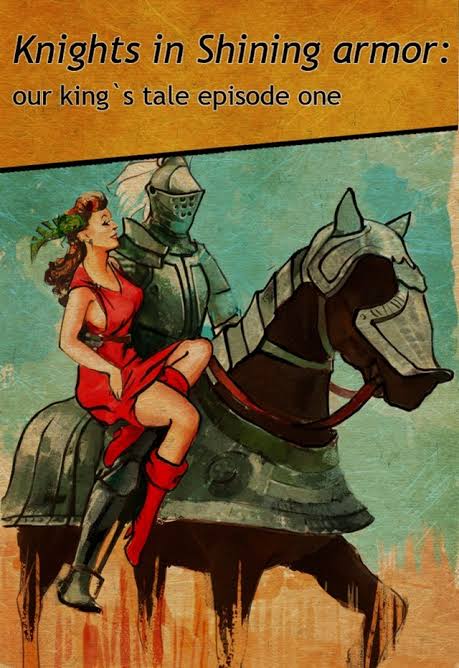
A KNIGHT IN SHINING ARMOUR definition: Someone who saves you from a difficult or dangerous situation.
An idealised or chivalrous man who comes to save a woman in a difficult situation can be called her knight in shining armor.
Saint Valentine was the greatest protagonist of love. He was executed on February 14th, AD 269. To commemorate the message of love propagated by Saint Valentine, Valentine’s Day is celebrated globally on February 14th. Many countries observe “Valentine’s Day” as a holiday.
The Roman Emperor Claudius II summoned Saint Valentine, the popular priest of the Roman Empire who spread the doctrine of love, and offered Claudius’ support to spread his message of love, in case Saint Valentine accepted the pagan religion. Saint Valentine rejected the proposal and became a martyr on the altar of love.
According to an early tradition, Saint Valentine restored sight to the blind daughter of his jailer. An 18th-century embellishment to the legend claims he wrote the jailer's daughter a note signed "Your Valentine" as a farewell before his execution.
Valentine's Day, also called Saint Valentine's Day or the Feast of Saint Valentine, is celebrated annually on February 14. It originated as a Christian feast day honoring a martyr named Valentine. Through later folk traditions, it has also become a significant cultural, religious and commercial celebration of romance and love in many regions of the world.
According to findings, Singaporeans are among the biggest spenders on Valentine's Day, with 60% Singaporeans indicating that they would spend between $100 and $500 during the season leading up to the holiday.
In the UK, just under half of the population spends money on their Valentines. Around £1.3 billion is spent yearly on cards, flowers, chocolates, and other gifts, with an estimated 25 million cards sent.
The U.S. Greeting Card Association estimates that approximately 190 million Valentine's Day cards are sent each year in the US. Half of those valentines are given to family members other than husband or wife, usually to children. When the Valentine-exchange cards made in school activities are included, the figure rises to 1 billion, and teachers become the recipients of the most Valentine's.
Valentine's Day is a major source of economic activity in the US, with total expenditure topping $18.2 billion in 2017, or over $136 per person. This was an increase from $108 per person in 2010. Purchases include jewellery, flowers, chocolates, candy, and greeting cards. Roses, especially red roses, are the most popular flowers.
The rise of the Internet around the turn of the millennium has created new traditions surrounding Valentine’s Day. Each year, millions of people use digital platforms to create and send greeting messages such as e-cards, love coupons, and printable cards. For many, these online expressions of affection have become just as meaningful as traditional paper cards. However, some critics argue that Valentine’s Day has become overly commercialized and consider it a “Hallmark holiday,” suggesting that it is driven more by marketing and consumer spending than by genuine romance.
Valentine's Day customs—sending greeting cards (known as "valentines"), offering confectionery and presenting flowers—developed in early modern England and spread throughout the English-speaking world in the 19th century. In the late 20th and early 21st centuries, these customs spread to other countries, like Halloween and aspects of Christmas (such as Santa Claus).
Valentine's Day is celebrated in many East Asian countries, with Singaporeans, Chinese, and South Koreans spending the most money on Valentine's gifts.
From January to December, Koreans celebrate the 14th of every month, the sequence of these days is Candle Day, Valentine's Day, White Day, Black Day, Rose Day, Kiss Day, Silver Day, Green Day, Music Day, Wine Day, Movie Day, and Hug Day. Korean women give more chocolate on Valentine's Day than Japanese women.
In ancient India, there was a tradition of adoring Kamadeva, the lord of love – exemplified by the erotic carvings in the Khajuraho Group of Monuments and by the writing of the Kamasutra. This tradition was lost around the Middle Ages, when Kamadeva was no longer celebrated, and public displays of sexual affection became frowned upon. This repression of public affections began to loosen in the 1990s.
The urban elites and middle-class citizens of India celebrate "Valentine's Day".
Lions and Lilies, a website (2013), highlights the knight in shining armor as one of its favorite topics.
Home to the series of novels 'Lions and Lilies'
The Lily and the Lion (Lions and Lilies)
A four book series - Book 1 - Catherine Wilson

Separated in infancy, rediscovered by chance, can they unravel a mystery and find a way to reunite?
Wistful and passionate, the wayward Cecile d'Armagnac has enjoyed the indulgent childhood of a French noble, but life for the young woman is about to change when she learns of her sister's plight.
Catherine Pembroke, a naive novice, has endured a lonely existence behind convent walls, when Cecile's letter is intercepted by the malicious Earl of Salisbury, the shy nun is thrust into a dangerous and foreign world. Placed into the custody of a cynical knight, Simon Marshall, Catherine struggles to unravel a past that threatens her future as William of Salisbury begins his own hunt - after the girls - hoping to use them as pawns in his desperate quest for power.
Trapped by one of England's most powerful lords, Cecile yields to him to save her sister. She flees with the aid of the King's courier, Gillet de Bellegarde, but will her journey see her lose all she holds dear, or just her heart?
In an age when women have control over their lives, Cecile and Catherine find themselves immersed in political turbulence, intrigue, danger and romance. Their hopes of meeting are thwarted by the powerful men around them - even as they provide both distraction and passion, for none appear to be who they claim.
The Lily and the Lion will catapult you into a world when knighthood was revered, and love was to be cherished.
"The Lily and the Lion" is a classic
Brothers Grimm fairy tale (also known as
The Singing, Springing Lark in some translations).

The Request: A merchant travels to find a rare rose for his youngest, dearest daughter, Lily, but is confronted by a lion who guards the flower.
The Pact: The merchant agrees to give the lion the first thing that meets him upon his return home, which is his daughter, Lily.
The Enchantment: The lion is actually a prince cursed to be a beast by day, who lives in a castle with his court.
The Quest: After a rival princess steals the prince away, Lily travels across the world, receiving help from the sun, moon, and wind to break the spell.
This story is a variation of the
Beauty and the Beast archetype, highlighting themes of love, loyalty and endurance.
The modern cliché Valentine's Day poem can be found in Gammer Gurton's Garland (1784), a collection of English nursery rhymes published in London by Joseph Johnson:
"The rose is red, the violet's blue,
The honey's sweet, and so are you.
Thou art my love and I am thine;
I drew thee to my Valentine:
The lot was cast and then I drew,
And Fortune said it shou'd be you."
While pips were highly variable, courtesan cards – called “face cards” today - have remained largely unchanged for centuries. British and French decks, for example, always feature the same four legendary kings: Charles, David, Caesar, and Alexander the Great. The queens have not enjoyed similar reverence.
The Queen's Greek Goddess Athena/Pallas (some sources state Pallas is a friend of Athena), for Spades, Isabeau (or Isabella), wife of the mad King Charles VI of France, for Clubs. NB. In other sources, this is attributed to the biblical Judith, who saves Israel from the Assyrians by killing an Assyrian general, Holofernes.Jacob’s wife, Rachel, for Diamonds, and Argine (an anagram of Regina – Latin for Queen) for Diamonds.
ATHENA – SPADES
The Guardian says Pallas, the Queen of Spades, can be identified with the Greek goddess Athena, who was also sometimes called Pallas.
{Courtesy Lions and Lilies website}.
A vision of beauty, so full of grace,
By her presence alone, I forget my woes
And I gaze upon that fairy face,
Soft as dew upon a rose
My heart is pounding within my breast
Lo! What is this wonder I behold?
By a gentle touch, she can tame the beast
And turn lowly squire to warrior bold.
What is this ache that tears me apart?
Bitter-sweet within its grasp
Wouldst she look my way?
I ponder her beauty, her softness, her love
And know that I must stay
A thousand tortured deaths I die
And yet my love will have its fill
The sweetness of that kiss, I dream
The touch of lips was never meant.
Saint Valentine's Day is mentioned ruefully by Ophelia in William Shakespeare's Hamlet (1600–1601): "Tomorrow is Saint Valentine's day, All in the morning betime, And I am a maid at your window, To be your Valentine. Then up he rose and donned his clothes, And dupp'd the chamber-door; Let in the maid, that out a maid Never departed more."— William Shakespeare, Hamlet, Act IV, Scene 5
Valentine's Day has been celebrated for many centuries. St. Valentine secretly blessed the weddings of love-smitten couples and served as their knight in shining armor until Emperor Claudius II found out about his act and ordered the execution of an unwilling Valentine, who refused to convert to Claudius' Pagan religion to spread his doctrine of love.


Comments
Post a Comment