HELEN OF TROY - THE STORY BEHIND THE MOST BEAUTIFUL WOMAN IN THE WORLD
HELEN OF TROY - THE STORY BEHIND THE MOST BEAUTIFUL WOMAN IN THE WORLD
The Love of Helen and Paris by Jacques-Louis David (oil on canvas, 1788, Louvre, Paris).
Helen of Troy, known as the most beautiful woman in the world, was a pivotal figure in Greek mythology whose elopement with Paris of Troy triggered the Trojan War. As the daughter of Zeus and Leda, she was married to King Menelaus of Sparta before leaving with Paris, leading to a ten-year siege.
Today, the phrase "The Face That Launched a Thousand Ships" is most commonly used as a metaphor for beauty and its seductive and destructive force. The ravishing beauty of damsels has always led to the downfall of heroic men throughout human history.
Because of her beauty, she had dozens of powerful suitors. To prevent war between them, her stepfather King Tyndareus made them swear the Oath of Tyndareus—a vow to defend her chosen husband against anyone who would take her away. She eventually married Menelaus, the King of Sparta. The other suitors vowed to support Menelaus in case of an abduction of Helen by anyone in the future.
In her youth, she was abducted by Theseus and subsequently rescued by her brothers. At the time of marriage to Menelaus, she was still very young and was an irresistible beauty. Menelaus knew that such abduction might happen again.
The Trojan prince Paris was promised the most beautiful woman in the world by the goddess Aphrodite after he judged her the "fairest" in a divine contest. Paris visited Sparta and either seduced or kidnapped Helen, taking her to Troy.
According to Homer's The Iliad, Helen was the wife of the king of Sparta, Menelaus. She was so beautiful that Greek men went to Troy and fought the Trojan War to win her back from her lover, Paris. The "thousand ships" in Marlowe's play refers to the Greek army that set sail from Aulis to wage war against the Trojans and burn Troy (Greek name: Ilion).
Helen had been abducted before she married Menelaus, so he knew it could happen again. Before Helen of Sparta married Menelaus, all the Greek suitors, and she had had quite a few, swore an oath to aid Menelaus should he ever need their help retrieving his wife. Those suitors or their sons brought their own troops and ships to Troy.
The Trojan War may have actually happened. The stories about it, best known from the author known as Homer, say it lasted 10 years. At the end of the Trojan War, the belly of the Trojan Horse (from which we get the expression "beware of Greeks bearing gifts") sneakily transported Greeks into Troy, where they set fire to the city, killed the Trojan men, and took many of the Trojan women. Helen of Troy returned to her original husband, Menelaus.
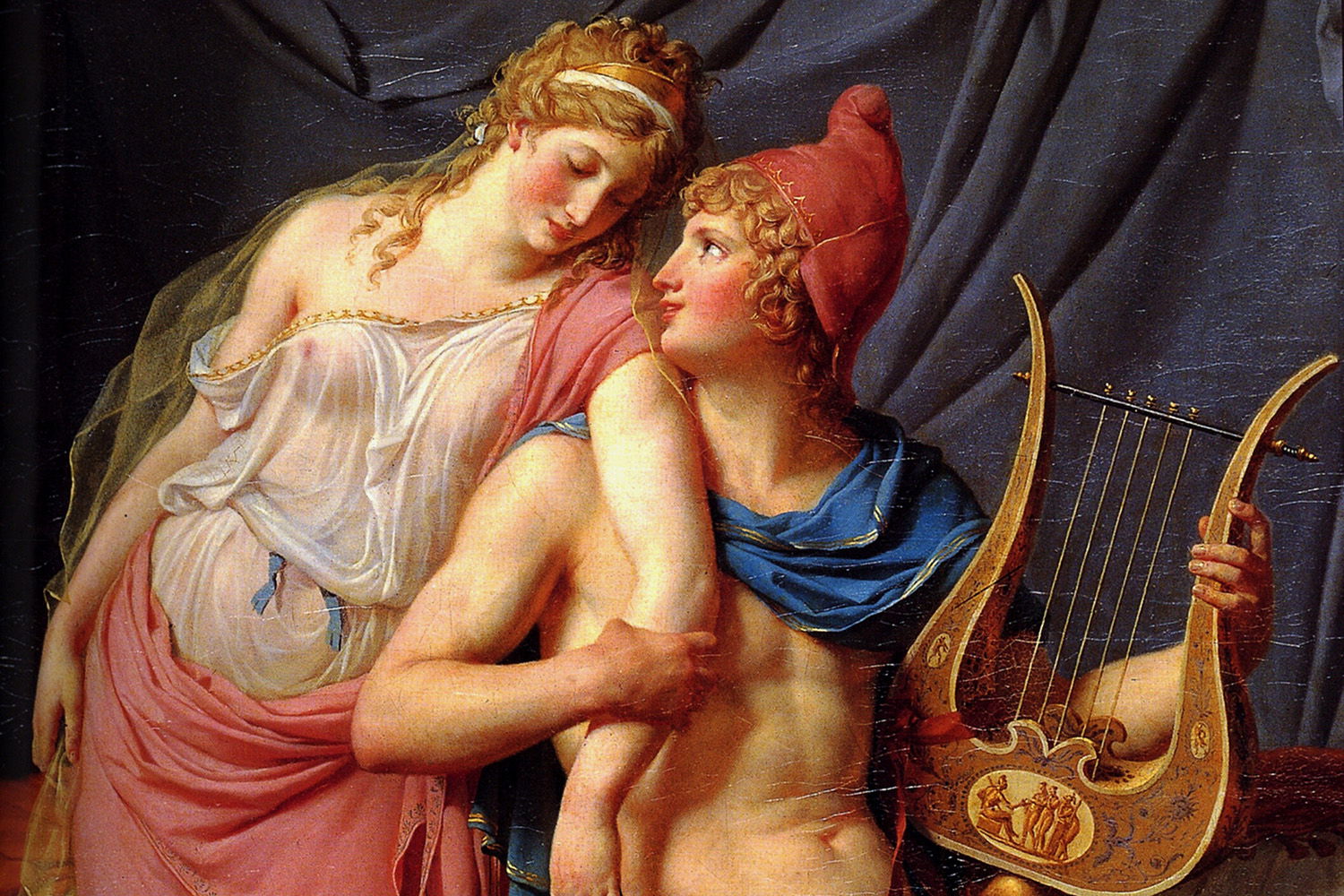
Helen and her lover Paris of Troy
Elements of her putative biography come from ancient Greek and Roman authors such as Homer, Hesiod, Euripides, Virgil, and Ovid.
In the archives of Trinity Hall College, Cambridge, there is an infrequently studied medieval manuscript. Created in 1406, it is an illustrated version of Boethius’ sixth-century Consolation of Philosophy. The Consolation is a fusion of Christian and Pagan principles, written in an attempt to identify the root of happiness, and set down while the author, Boethius, was awaiting execution in Pavia. On one page of the discolored parchment, Helen of Troy, dressed in the fashionable robes of the day, stands on a parapet while flags flutter on the towers of the castle behind her; she stares down at Paris, who is climbing up to greet her. Helen has a flick of rouge on her cheeks. She grips Paris’ shoulders firmly, hauling him up towards her and to infidelity.
In those days, the exchange of gifts was prevalent amongst the Greeks. Wealth and status were displayed through possessions. Paris, as a prince of Troy, would plausibly be associated with wealth and refinement.
Prince of Troy, Paris, offered Helen precious fabrics, hidden treasures in the form of expensive jewels, and the promise of an enviable lifestyle if she married him, in addition to his deadly youthful charm and beauty. Some named her the epitome of beauty and an object of desire, and she was an easy prey to fall for luxury and passionate sex. The carnal instincts and the peak of passion amounted to death for some of those who lusted after her. However, these attributes were not mentioned in Homer's 'Iliad' but rather in the interpretations of some modern writers.
Ancient Greek myths usually explain Helen’s departure differently:
- Aphrodite promised Helen to Paris
- Desire is often portrayed as divinely induced, not purely transactional
- In some accounts, Helen herself says she was overpowered by fate or the god
After the fall of Troy and the death of Paris, his mother Hecuba is often portrayed as grieving and angry. In some versions of the myths and later literary retelling, she does indeed blame Helen for the destruction of Troy, since Paris brought Helen from Sparta, which amounted to the Trojan War.
Some authors and traditions attribute Helen as the central cause of destruction, stating that she willingly left Sparta with Paris and her beauty as dangerous and destructive.
In these versions, Helen is portrayed almost like a femme fatale—someone whose choices (or allure) bring ruin.
The phrase "beware of Greeks bearing gifts" originated from the Trojan War. The Greek soldiers were hiding in the belly of a giant wooden horse, an offering to Athena, the Goddess of Wisdom and War, by the Greeks to cart into the city of Troy.
Although we now tend to think of Helen as a passive figure, a feeble thing swept along to Troy on the tide of Paris’ libido, the simpering shell immortalized in Wolfgang Petersen’s movie Troy (2004), a close study of representations of Helen through the centuries yields a feistier figure. She is a woman who is at times applauded, but more often damned, for being sexually active – and is, furthermore, branded a whore. Helen of Troy is a telling icon: a woman who impacted on the world around her – as one of the earliest named authors of the West, Hesiod declared in his Works and Days: ‘[there was] a god-like race of hero men ... grim war and dread battle destroyed a part of them ... [war] brought them in ships over the great sea gulf to Troy for rich-haired Helen’s sake’ – but whose impact has to be explained away in terms of a shabby sale of sex.
Stories of her beauty have inspired artists and writers to represent her as the personification of ideal human beauty. Images of Helen started appearing in the 7th century BC. In Classical Greece, her elopement—or abduction—was a popular motif. In medieval illustrations, this event was frequently portrayed as a seduction, whereas in Renaissance paintings it was usually depicted as a "rape" (i. e., a forced abduction) by Paris.

The Rape or forced abduction of Helen
After the fall of Troy and the death of Paris, Helen was reunited with Menelaus. Menelaus wanted to kill his unfaithful wife, who had eloped with Paris after betraying him. He raised the sword to kill her, and at the very moment, Helen dropped her robe from her shoulder, revealing her alluring naked beauty. Overwhelmed by the sight of her beauty, the sword was dropped from Menelaus's hand. Menelaus accepted her without any complaint, and they lived together thereafter.
Though other versions of the legend recount her ascending to the abode of the gods at Mount Olympus instead. A cult associated with her developed in Hellenistic Laconia, both at Sparta and elsewhere; at Therapne, she shared a shrine with Menelaus. She was also worshiped in Attica and on Rhodes.
The tale of Helen of Troy explores how beauty, desire, and obsession can lead to irrational behavior and even self-destruction.


Comments
Post a Comment