"THE MOON IN THE GUTTER" (La Lune Dans Le Caniveau) - A 1983 FRENCH MOVIE
"THE MOON IN THE GUTTER" (La Lune Dans Le Caniveau) - A 1983 FRENCH MOVIE
The Moon in the Gutter is a 1983 French drama film directed by Jean-Jacques Beineix. It was entered into the 1983 Cannes Film Festival.
The film stars Gérard Depardieu, Nastassja Kinski, and Victoria Abril in the lead roles.
An obsessed dockworker (Gérard Depardieu) meets an unreal beauty (Nastassja Kinski) in a red sports car.

The Moon in the Gutter is a love triangle composed of a working-class man and two women of opposite economic classes.
The writer watched this film at the International Film Festival held in Bombay in 1983. I was impressed by the special effects, especially the psychedelic color bottle floating in the sea, which was new to films of that era.

From the director of Betty Blue and Diva, The Moon in the Gutter is very much style over substance, probably more than any other Cinema du Look movie I have seen. Whatever plot there is is put on the back burner in favor of the visuals. I don't mind, though, because it looks great. Plus, the performances by Gerard Depardieu, Nastassja Kinski, and Victoria Abril (starring in a role similar to Beatrice Dalle's in Betty Blue) are really solid.
I think this was a film created on purpose to draw young people’s attention with all the ingredients that arouse their curiosity, stylistic excess, intense moments of decadence, poetic “maudit” character, amour fou beyond the borders of death, and heartbreaking music. Pretending to draw inspiration from a novel by David Goodis, Jean-Jacques Beineix builds a sort of noir cathedral, which he then dismantles one piece at a time. The obsession of the dock worker Gérard Depardieu, who devotes his life to searching the rapist and killer of his sister, becomes a sort of postmodern ballad where everything is false (the whole set is a reconstruction). The visuals represent poetry (the moon) and sordidness (the drainage canal) and are part of the Decadent tradition, ranging from Baudelaire to Buñuel.
Charles-Pierre Baudelaire was a French poet, essayist, translator, and art critic. His poems are described as exhibiting mastery of rhythm and rhyme, as containing an exoticism inherited from the Romantics, and as being based on observations of real life.
Luis Buñuel Portolés was a Spanish filmmaker who worked in France, Mexico, and Spain. He has been widely regarded by film critics, historians, and directors as one of the greatest and most influential filmmakers of all time.
SYNOPSIS:
It might seem obvious that the title of The Moon in the Gutter refers to Gérard’s sister Catherine, who killed herself after being raped in the port district of Marseille, because it’s her blood in a gutter that reflects the moon. The title is a poetic metaphor for the contrast between a heavenly object and the filthy underworld, where its radiance is so out of place. This metaphor, however, applies equally well to Loretta Channing, Nastassja Kinski’s character, a glamorous woman who descends from a mansion in the hills to the seedy port, slumming with masculine stevedore Gérard Delmas.
The key to The Moon in the Gutter is to identify the link between Catherine and Loretta, the two "moons" in this dark world. Without this connection, the movie is lost, which partly explains its dismal critical reception.
If you want to read about critical acclaim, then search for my earlier Blogs about INTERSTELLAR, AVATAR, BALLAD OF NARAYAMA, and MANON OF THE SPRINGS, etc.
Catherine and Loretta look alike. They share the same build, skin tone, and flowing dark hair. Above all, both women are introduced as someone’s sister. Catherine was a sister to Gérard and Frank, each of whom suspects the other of the rape. Each has good reason to suspect the other of incest. A flashback in the morgue shows Gérard caressing his sister’s body from her feet to her breasts, and Frank describes the déjà vu he felt while staring at Loretta in the bar, referring, of course, to her similarity to Catherine. Gérard’s attraction to Loretta is psychologically suspect, given how alike the two women are. When Gérard goes into his dead sister’s bedroom to recall their childhood memories, Loretta’s theme plays on the soundtrack. Loretta is Newton’s sister, and we’re told they share a close bond. Newton, too, has a history of incest, but more to the point, it’s Newton’s mention of Loretta as his “sister” that piques Gérard’s interest in her before they even meet.

Gérard’s illicit attraction to Loretta, the woman who so clearly reminds him of his sister, is established in two extraordinarily cinematic scenes. The first is her initial appearance. A roll of thunder underscores Newton’s second mention of his sister, and a moment later, she arrives to pick up her drunken brother. The headlights of her Ferrari bathe the dark barroom in warm colors; the revving engine heralds her arrival; her eyes appear above the etched glass; the door handle turns slowly; Loretta’s musical theme surges as the doorway frames her like a painting; and a fan tousles her wavy hair. It’s hard to think of a more dramatic entrance in any movie. It’s a consummate picture of glamor.
The second half of Loretta’s introductory portrait comes eighteen minutes later when she picks Gérard up at his house. Her Ferrari stops in front of a billboard for Stromboli Beer, and the tagline “Try Another World” translates what Gérard must read in her eyes as she leans back seductively in the driver’s seat. She looks like a model emerging from the advertisement behind her. As she rises slowly, a low-angle shot frames her like a goddess. Again, she’s glamor personified.

Here exactly is the movie’s point. It means linking two words that are not normally joined: “glamor” and “incest”. The movie connects these words not in fiction or in theory, but in real life, demonstrating that the desire to possess a glamorous object is rooted in incest. Here, it’s necessary to understand that glamor is not the same thing as beauty, sexiness, or attractiveness. Gérard’s girlfriend, Bella, has all those qualities, but he wants Loretta because, unlike Bella, she has glamor. Glamor is a surplus quality that idealizes its object, elevating it above ordinary life. It transforms a woman, in her worshiper’s eyes, into a princess or a goddess or any other impossible ideal. When "The Moon in the Gutter" equates glamor with incest, it reminds us that glamor is psychologically regressive, taking the beholder back to an infantile state when he formed an unrealistically ideal image of someone, usually a close family member.
The film treats glamour not as simple beauty or excitement, but as a seductive illusion that pulls people away from ordinary reality. The Stromboli billboard slogan, “Try another world,” becomes symbolic of escapism: it promises access to something more thrilling, beautiful, or meaningful than everyday life, yet that promise is ultimately deceptive.
The implicit contrast between a moon and a gutter runs through the entire film, always pointing to the gap between what’s glamorous and what’s not. The Channing mansion could hardly be more different from Gérard’s “crummiest house around”. In Loretta’s presence, Gérard’s whole world turns into a fantasy, even the port of Marseille. Her Ferrari glides along the light-speckled dock at night as if floating through a man-made galaxy, while flocks of seagulls skim over the water. The wedding church sits dramatically on a seaside cliff like an illustrated fairy tale, as if Gérard has slipped back into childhood, unable to distinguish between dream and reality. After the wedding, he dresses up, slicks back his hair like a social climber, and plays a hero when Bella sends thugs after him. Loretta is seeking her own version of glamor in the gutter, where she believes men are stronger and more heroic. When she photographs Gérard at work, even after he hits her, she looks at him with a perverse desire.

As Alfred Hitchcock’s movies tell us in so many ways, a man who regresses into pre- adolescent sexuality, including a man seduced by glamor like Gérard, is dangerous to himself and others, especially to the women who cross his path. There’s nothing innocent about a return to childhood. Rather than bringing out the playfulness and sweetness of a young boy, it tends to bring out selfishness, impetuousness, and entitlement.
The Moon in the Gutter is far from a Hollywood movie, and its story undermines the dramatic effect of its most glamorous and most exciting scenes. Its failure at the box office probably stems as much as anything from its refusal to indulge audiences with the mystery of Catherine’s rapist. The man is never caught, and he’s only perfunctorily identified when a pair of red shoes stepping off a bus tells us that he’s a dock worker. More important is Gérard’s psychological guilt. He’s not the rapist, but his sexual interest in his sister leads him to betray Bella, and it opens the question of what circumstances led to his sister’s suicide. Was she thinking of how her brother would react to her rape?
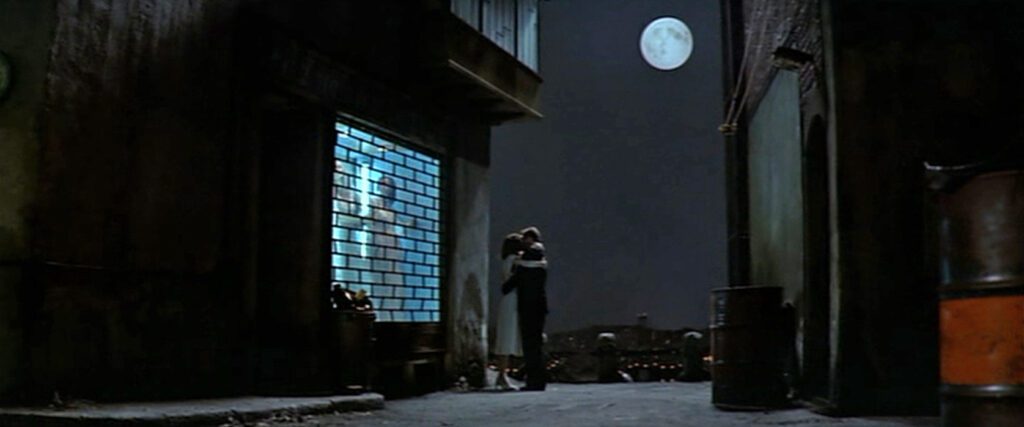
The movie forgoes audience satisfaction to define the psychological reality and effects of glamor, and to trace the road to the maturity of a man who, like so many others, has learned to desire glamor in women. At the end, after nearly killing his brother on a false suspicion, he stands in the spot where Catherine had died, wearing the same watch and holding the same razor, vowing once again to find her rapist. Suddenly, Loretta drives up as if he had conjured her, looking more like Catherine than ever. Now it’s clear that his wish to be his sister’s hero is inseparable from his wish to be Loretta’s lover. Confronted with the similarity of his two wishes, he finally understands that his attraction to Loretta is tainted and could never be called love. At the end, he returns to Bella, who may not be an ideal of purity or glamor, but at least she belongs to the real world.
It examines the insights into the psychology and social consequences of adult incest. The movie is a critique of glamor as a desire rooted in incest.
Hollywood is singled out as a force of deception, seducing people with glamor.
TRIVIA :
Diahnne Abbott, Robert De Niro's then-wife, was originally signed to co-star but quit when asked to perform in the nude. Her part was ultimately played by Victoria Abril.
The film has a run time of 2 hours and 18 minutes.
**********************


Comments
Post a Comment