THE GREAT BEAUTY - LA GRANDE BELLEZZA (2013)
THE GREAT BEAUTY - LA GRANDE BELLEZZA (2013)
The Great Beauty (Italian: La grande bellezza) is a 2013 art drama film co-written and directed by Paolo Sorrentino. Filming took place in Rome starting on 9 August 2012. It premiered at the 2013 Cannes Film Festival, where it was screened in competition for the Palme d'Or. It was shown at the 2013 Toronto International Film Festival and the 2013 Tallinn Black Nights Film Festival (where it won the Grand Prix), and it also won the 2013 Reykjavik European Film Festival.
The film won Best Foreign Language Film at the 86th Academy Awards, as well as the Golden Globe and the BAFTA award in the same category. It is a co-production between the Italian Medusa Film and Indigo Film and the French Babe Films, with support from Banca Popolare di Vicenza, Pathé, and France 2 Cinéma. With a production budget of €9.2 million, the film grossed over $24 million worldwide.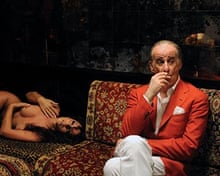
Toni Servillo in a still from La Grande Bellezza (2013)
Synopsis: An aging writer bitterly recollects his passionate youth.
PLOT:
The film opens with a quote from Louis-Ferdinand Céline's novel Journey to the End of the Night: "Travel is useful; it exercises the imagination. All the rest is disappointment and fatigue. Our journey is entirely imaginary. That is its strength. It goes from life to death. People, animals, cities, things – all are imagined. It's a novel, just a fictitious narrative. Littré says so, and he's never wrong. And besides, in the first place, anyone can do as much. You have to close your eyes. It's on the other side of life."
Jep Gambardella is a 65-year-old seasoned journalist and theater critic, mostly committed to wandering among the social events of a Rome immersed in the beauty of its history and in the superficiality of its inhabitants today, in a merciless contrast. He also ventured into creative writing in his youth; he is the author of only one work, titled The Human Apparatus. Despite the appreciation and many awards he received, Jep has not written any other books, not only because of his laziness but, above all, because of a creative block which he cannot escape. The purpose of his existence has been to become a "socialite", but not just any socialite, but "the king of society".
Jep is surrounded by several friends: Romano, a playwright who is perpetually in the lead of a young woman who exploits him; Lello, a mouthy and wealthy toy seller; Viola, a wealthy bourgeois and mother of a son with serious mental problems named Andrea; Stefania, a self-centred radical chic writer; Dadina, the dwarf editor of the newspaper where Jep works.
One morning, he meets the husband of Elisa, a woman who has been Jep's first and probably only love: the man announces that Elisa has died, leaving behind only a diary in which the woman tells of her love for Jep; thus, her husband discovers that he had been a mere surrogate for 35 years, nothing more than "a good companion". Elisa's husband, now afflicted and grieved, will soon find consolation in the affectionate welcome of his foreign maid. After this episode, Jep begins a profound and melancholic reinterpretation of his life and a long meditation on himself and on the world around him. And, above all, he thinks about starting to write again.
During the following days, Jep meets Ramona, a stripper with a personal secret, and Cardinal Bellucci, in whom an interest in cooking is more present than in his Catholic calling; Jep is gradually convinced of the futility and uselessness of his existence. Soon his "vicious circle" also breaks down: Ramona, with whom he had established an innocent and profound relationship, dies of a terminal disease; Romano, disappointed by the deceptive attractiveness of Rome, leaves the city, seeking out only Jep to say goodbye to; Stefania, socially humiliated by Jep, who had revealed her secrets and highlighted her hypocrisy, parts Jep's social friend circle. Viola, on the other hand, after the sad demise of her son, donates all her possessions to the Church and becomes a missionary in Africa.
Just when hope seems to abandon Jep once and for all, he is saved by a new episode: after a meeting, pushed by Dadina, who wants to get an interview with a "Saint", a Catholic missionary nun in the Third World, Jep goes to Giglio Island to report on the shipwreck of the Costa Concordia. Right here, after his first meeting with Elisa in a flashback, a glimmer of hope rekindles in him.
For decades, journalist Jep Gambardella has charmed and seduced his way through the glittering nightlife of Rome. Since the legendary success of his only novel, he has been a permanent fixture in the city’s literary and elite social circles. But on his sixty-fifth birthday, Jep unexpectedly finds himself taking stock of his life, turning his cutting wit on himself and his contemporaries, and looking past the lavish nightclubs, parties, and cafés to find Rome itself, in all its monumental glory: a timeless landscape of absurd, exquisite beauty. Featuring sensuous cinematography, a lush score, and an award-winning central performance by the great Toni Servillo, this transporting experience by the brilliant Italian director Paolo Sorrentino is a breathtaking Felliniesque tale of decadence and lost love.
An instant favorite. So overwhelmed. The Great Beauty is cinematic therapy by a director in full control of his medium. Sorrentino somewhat discards the narrative here; instead, he is capturing moments, day-to-day experiences, fragmented memories, and emotions. A total vibe movie about self-discovery and the different ways in which beauty can enter one’s life. The photo exhibition scene truly got me choked up.
CAST :
- Toni Servillo as Jep Gambardella
- Carlo Verdone as Romano
- Sabrina Ferilli as Ramona
- Carlo Buccirosso as Lello Cava
- Giovanna Vignola as Dadina
- Iaia Forte as Trumeau, Lello's wife
- Pamela Villoresi as Viola
- Galatea Ranzi as Stefania
- Franco Graziosi as Count Colonna
- Giorgio Pasotti as Stefano
- Massimo Popolizio as Alfio Bracco
- Sonia Gessner as Countess Colonna
- Luca Marinelli as Andrea, Viola's son
- Serena Grandi as Lorena
- Ivan Franek as Ron Sweet
- Giusi Merli as Sister Maria
- Anita Kravos as Talia Concept
- Roberto Herlitzka as Cardinal Bellucci
- Isabella Ferrari as Orietta
- Fanny Ardant as herself (uncredited)
- Antonello Venditti as himself (uncredited)
Sabrina Ferilli
It's a phenomenally beautiful movie.
The best comparison I can make is that Emmanuel Lubezki and Larry David decided to collaborate on a film together in Rome.
And the reason this film works so well as both a comedy and a poignant meditation on humanity is its perfect pacing; it is carefully constructed and meticulously organized in each frame.
The world is a gorgeous, ugly place.
"Beyond there is what lies beyond.
I don't deal with what lies beyond.
Overlooking the eternal Colosseum, the moonlit terrace of the cynical intellectual and fiercely fashionable king of decadent Rome's nightlife--one-off novelist Jep Gambardella--is the ideal place to contemplate life, mortality, art, and fleeting youth. For decades, the elegant sexagenarian journalist has been living in an endless party; however, the invincible death is here to remind Jep that all good things must come to an end, including his lavish but superficial lifestyle. Now, intimate but temporary acquaintances attempt to stimulate the perpetually uninspired writer, but in the endless search for undiluted beauty, one needs an awakening, even a rude one.
Against the backdrop of a mysterious and wonderful Rome, our main character slowly rediscovers beauty in the monotonous, empty shell of a lifetime between sinners. Following a boring night spent between the sheets with a boring and egocentric rich woman from Milan, Jep decides to stick to a quieter quality of life, but several casual meetings will force him to reconsider his priorities. A stripper on the verge of a breakdown, the ex-husband of his first love, a bizarre magician, and a living Saint from a far-away reality will soon allow Jep to discover his own personal Great Beauty.
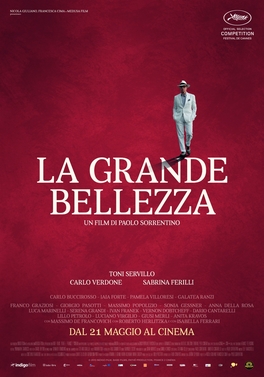
Italian theatrical release poster
Various critics named the film one of the best of 2013.
Peter Bradshaw also named the film one of the 20 best films of the 21st Century in The Guardian.
The film has a 91% approval rating on Rotten Tomatoes, based on 135 reviews, with a weighted average rating of 8/10. The website's critical consensus states, "Dazzlingly ambitious, beautifully filmed, and thoroughly enthralling, The Great Beauty offers virtuoso filmmaking from writer/director Paolo Sorrentino." The film holds a score of 86/100 on Metacritic based on 34 reviews, signifying "universal acclaim".
Wild set pieces and rueful observations are the highlights of this Italian film by one of the modern masters of cinema, Paolo Sorrentino.
The movie has a runtime of 2h 22m.
One reviewer has written that it is an astonishing cinematic feast, and another has opined that it is a dazzling, exuberant, and exhilarating movie.
Self-conscious twenty-first-century version of the Fellini classic, La Grande Bellezza is a visual feast, one of the relatively few films that take full advantage of the extraordinary, almost hallucinatory beauty of Rome.
The Great Beauty is an outlandishly entertaining film.
Dazzlingly ambitious, beautifully filmed, and thoroughly enthralling, The Great Beauty offers virtuoso film making from writer/director Paolo Sorrentino.
***************************


Comments
Post a Comment